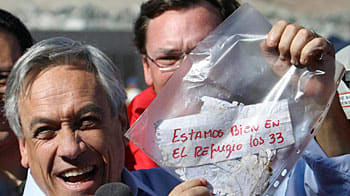
President of Chile Reads Letter From Miners
"Dear Lila, I'm fine. Thanks to God I volition come out soon, patience and faith. God is not bad," read the note from Mario Gómez, a 63-yr-one-time miner trapped forth with 32 others for xviii days deep secret, later a tunnel complanate.
Written to his married woman Lilian from almost one-half a mile below the harsh Atacama Desert, and attached to a probe rescuers had managed to poke through a tiny hole they had drilled, the note was hailed for its simple elegance.
Gómez "made the whole of Chile cry with a letter of the alphabet," read the headline in the tabloid Las Últimas Noticias.
"The whole country had no hope of finding them live, so it really was a miracle and we all cried," said Karin Morales.
News that all 33 missing miners were still alive, trapped in the San José copper mine near Copiapó in the n of Chile, was greeted with jubilation—even as authorities warned they could be trapped downwards in that location for four months.
Relatives who had set upwardly a army camp they called "Esperanza"—promise—sang the national anthem. Spontaneous street parties erupted in the upper-case letter Santiago. Cries of "viva Chile" were heard, and flags were waved.
Coming months afterwards much of Chile was striking by a devastating convulsion that killed more than 500 and made 200,000 homeless, the men's survival is being taken every bit symbolic of the indomitable Chilean spirit.
"This result has provoked an essence of unity and salvation," said Marcelo Conrado, who works on prowl liners from Santiago. "If you call back about the fact that Chile has began the postal service-earthquake reconstruction process, this has given a greater impulse to the idea that we can make information technology regardless of the obstacles."
"The whole country had no promise of finding them alive, so it actually was a phenomenon and we all cried," said Karin Morales, who survived the earthquake and seismic sea wave in the southern urban center of Talcahuano with her family. "Imagine the spiritual force of these men. It's incredible."
After seven failed attempts to attain the men by drilling a hole, hopes had otherwise been fading. Rescuers blamed inaccurate visitor maps only on Sunday a photographic camera descended and showed dramatic images of their faces in the gloom.
The men sent up brief notes attached to the probe saying they had managed to accomplish a safety hole the size of a small apartment.
Having arrived by helicopter, a beaming President Sebastián Piñera confirmed the news and waved 1 of the messages. "Nosotros are well and in a refuge," it read. "The 33." Only celebrations were tempered by warnings that information technology could have up to four months to go the men out.
And as attending turned to the characters of the men being hailed as heroes, Mario Gómez, a miner since the age of 12, was being singled out as a leader of the trapped miners.
"He hasn't merely worked in a mine, which is brutal piece of work," his married woman told reporters. "He has slept in the outdoors, covered in paper-thin boxes, so I knew that in these moments he wouldn't let his companions get defeated."
Gómez appeared to exist ready for the look. "Even if we accept to await months to communicate," he wrote, "I desire to tell everyone that I'm good and we'll surely come out OK."
Rescuers accept already begun sending supplies and water downwards the hole. The men had managed to recharge their headlamps using the batteries from a digger and according to Gómez, had institute water nearby.
And Mario Gómez and his beau miners will demand all the force they can notice if information technology does accept until Christmas to bore a hole big enough to hoist them out i by one. A team of psychologists at the mine head will play a crucial role.
"The exchange of letters with families helps to keep morale high," psychologist Ana Arón, an practiced in crunch situations from Republic of chile's Catholic University, told the El Mercurio newspaper. "An essential trouble will be the psychological aftereffects," said Health Government minister Jaime Mañalich.
The Atacama Desert in northern Chile is the driest identify on Earth. Autonomously from the tourism found further north, in dusty little towns like San Pedro de Atacama, mining is one of the few industries this starkly beautiful 600-mile expanse of sand, rock, and dry out salt basins has.
The story of one of the other trapped miners illustrates this stark, economic reality. Fifty-three-year-old Franklin Lobos was a professional soccer thespian who even represented Chile in the 1984 Olympic Games. But later retiring from the sport he had gone to piece of work in the mine.
"Franklin Lobos went down the mine to keep his family," Manuel Rodríguez, quondam coach of Cobresal, ane of the teams Lobos played for, told Chilean news site noticiasweb.cl. "Cobresal never paid big wages."
Copper mining is the backbone of Republic of chile's economy—the country is the world'south biggest producer—and the government had hoped to employ a temporary increase in the mining tax to fund reconstruction after February's earthquake. But the measure was rejected by Congress.
In the immediate aftermath of the disaster, President Piñera sacked three members of Chile's mining regulatory body, Sernageomin. It emerged that because of upkeep deficits, the organization but had 16 safety auditors to cover more than 4,500 mines. In Atacama, only iii auditors embrace more than than 800 mining areas, said the Santiago Times.
Atacama senator Isabel Allende criticized the regulatory torso, the La Tercera newspaper reported, saying that the mine had suffered other accidents and been airtight for "lack of security" in 2007, only to reopen in 2008.
In July this yr, a regime inspection warned of "failure of fortification piece of work" and fined the company. Questions are being asked nearly why the mine had not been shut down earlier. "Most people believe the company is to blame for the disaster, forth with the authorities bodies that are supposed to oversee workers' well beingness and working conditions," said Conrado.
In his letter to his married woman, Mario Gómez also wrote: "The company needs to modernize." Chilean satirical magazine The Dispensary published an interview with former miner Ivan Toro, who lost his leg in an accident at the same San José mine in 2001 and criticized safety procedures.
"They were making us work in terribly dangerous places," Toro told the magazine. The interview was also printed in Chile's English linguistic communication newspaper, the Santiago Times.
A lawyer for the company, Hernán Tuane, told the local El Diario de Atacama newspaper that mine bosses may take to file for defalcation because of the cost of the rescue. "We don't have the cash flow necessary to sustain the obligations, considering as yous have seen that the mine is paralyzed," Mr Tuane said.
British announcer Dom Phillips moved to Sao Paulo, Brazil in 2007 to write his volume Superstar DJs Hither We Go (Random Firm/Ebury 2009) and works as a correspondent roofing news, economics, and celebrity. He now writes for The Times, People, Financial Times, and Grazia.
martinbehearring1978.blogspot.com
Source: https://www.thedailybeast.com/trapped-chilean-miners-send-a-message-about-being-alive
Post a Comment for "President of Chile Reads Letter From Miners"